

By Zach Spicer
AISIN Group has conducted its North American Quality Circle Convention Festival for 18 years.
Quality Circle is a yearlong development tool that includes supervisors and team members working together in teams to pick a project that will help the company improve its key performance indicators.
AISIN USA Mfg. Inc. in Seymour has always participated in the annual competition.
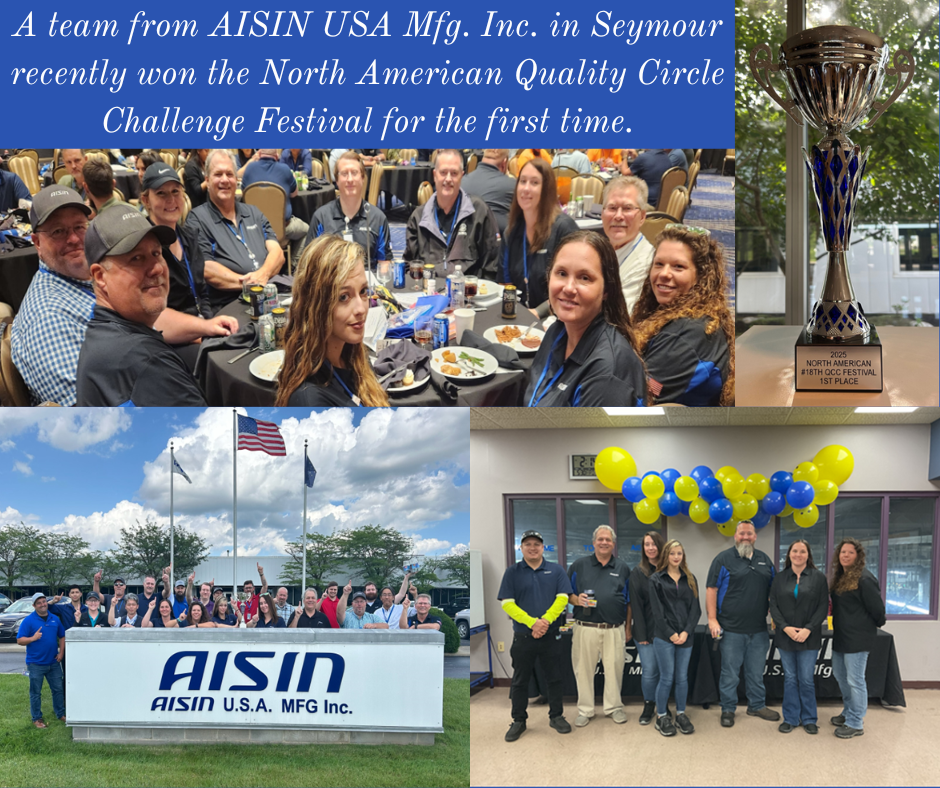
After general managers in eight areas of the facility choose their top team, the company’s officers listen to presentations to select the top three. Each top-three team receives a prize, and the winner advances to the North American competition.
There, they are among 18 AISIN companies in North America vying to finish in the top three to move on and present at the global competition in Japan.
This year, for the first time, a team from AISIN USA won the North American competition, which was June 18 and 19 at Caesars Southern Indiana in Elizabeth.
The presenting team consists of J.D. Fields, a supervisor; Dusti Rosas, a team lead; and Joe Brooks, a packaging specialist. The support team consists of Courtnie Ray, a general manager; Latasha Klakamp, a manager; and Kyla Sanders, a group leader. The QCC trainer is Jeremy Waskom, a supervisor.
Teams from 12 AISIN companies from North America, South America, Europe and Asia will compete in Japan.
“It’s really awesome to know that we made AUM history because we had never won before,” said Klakamp, a 15-year AISIN USA employee. “We’re hoping to be able to go over to Japan and see if we can continue to bring it home all the way. We want everybody to understand how much a little thing can do for so many people. That’s what they want.”
This year, 70 teams from AISIN USA worked on projects for several months, said Dustin Kiser, general manager of plant control.
Fields, Rosas and Klakamp work in the systems department, while Brooks works in packaging.
Fields, a supervisor, and Rosas, a team leader, came up with a way to change the direction boxes arrive to line operators so they don’t have to turn them around as they place parts inside to ship to customers.
“It came together because of the burden from the operators having an issue on the floor and they would have to turn a box,” Klakamp said. “We wanted to make it easier for them. They are in here all day long. We wanted to make their work as easy and simple and eliminate any burdens they have.”
Klakamp said they received team members’ feedback on their idea.
“There are tight spaces on the lines. We don’t want anybody to make it more difficult on them,” she said. “We listened to their burdens, we took their feedback and we wanted to make it better for them. The members understood they were heard.”
The team’s project also benefits logistics.
“When they put (boxes) onto the rack for them to bring to our line, they are going to use those arrows,” Klakamp said. “That way, they are already in the right direction, (and) they load them onto the wagon and bring them lineside. They then pick them up, (and) they are in the correct direction. It eliminates a lot of double-handling by a lot of team members.”
Rosas, who has worked at AISIN USA for five years, said all logistics has to do is look at the side of the boxes.
“It has the arrows on it, and they don’t have to look at the top of the box or unstack the boxes to tell which way to fit them in,” she said.
Brooks said he received approval of the change from all of the Toyota plants that are customers of AISIN USA.
“If you start labeling boxes, you’ve got to make sure they’re good with it,” he said.
Once everyone was on board, Brooks, a 29-year AISIN USA employee, said he appreciated the company’s officers for looking at a small change that would make a big impact.
Kiser said the project boosts team members’ morale.
“It’s always good to see that the simple ideas can make a big impact,” he said. “Honestly, we don’t think about that. We’re always wanting to spend money. We’re always wanting to put in some automation or something to fix a problem. Something as small as adding stickers to boxes could turn into a huge operational availability boost as well as a team member morale boost, and I think the knowledge learned along the way is very important to develop those future leaders.”
Klakamp said other AISIN USA departments and other companies could implement their idea.
“They are able to use our information we provided with them and take it back to their company and utilize it there for those members because we all share a lot of common parts, different models, so they have the same boxes at the other facilities,” she said.
Brooks liked seeing teams include people from different departments, including engineering, human resources and quality.
“They really mix it up, get different people involved to contribute, so I appreciated being a part of it,” he said.
Besides the team having a good idea, it helped that they included an entertaining element.
Part of the presentation showed support team members dancing the wrong direction. Later on, after the project team members explained how their idea would improve directional flow, they danced the right direction.
The project name, “One Direction,” and dance were an ode to the British pop boy band with the same name.
“There was some music and some dancing, and let’s face it, people like to laugh a little bit,” Brooks said.
AISIN USA had a sendoff for the team going to North American QCC and celebrated the win with ice cream. Next year, they hope to have more celebrating to do when they arrive home from Japan.
Meanwhile, Kiser said classes will start this month to teach the Quality Circle process to team members for the 2026 competition season. In August, teams will be decided, and they will pick a theme and get tested on their knowledge.
Next May, the top eight teams will present to management.
“It’s a development tool,” Kiser said. “If you want to learn, if you want to be challenged, if you want to move up within the company, this is a good tool to gain that knowledge and move up the TPS process, Toyota Production System, and how it works.”